The move of the Dodgers from Brooklyn to Los Angeles was before my time, and I sheepishly have to confess that I was not aware of this bit of history before I came across this short documentary by Vox. While these sorts of events are certainly not unique to Los Angeles, I do think it is important to ensure that episodes like this stay at the forefront of the public consciousness (or get introduced to folks who, like me, are not aware of these kinds of details).
Tommy Lasorda was born September 22, 1927. He was a hardcore baseball lifer, playing for the Brooklyn Dodgers in 1954 and 1955 and for the Kansas City Athletics in 1956. After retiring from playing, Lasorda worked as a scout for the Dodgers and eventually worked his way into coaching. He coached for the Dodgers from 1973 through 1976 before taking over as manager of the club. Lasorda led the Dodgers to four NL pennants and two World Series championships during his tenure. Upon retiring from the managerial position in 1996, he continued to work for the Dodgers in a variety of roles for the rest of his life.
Lasorda was inducted into the Baseball Hall of Fame in 1997 as a manager in his first year of eligibility. He died January 7, 2021 from a cardiopulmonary arrest in Fullerton, California at the age of 93.
On November 24, 1953, Dodger owner Walter O’Malley announced that Walter Alston would be the new manager of the Brooklyn team, replacing Chuck Dressen. The announcement came as a shock to reporters, as the leading candidate for the job had been the fan-favorite Pee Wee Reese. Alston would go on to win seven pennants and four World Series during his 23 years with the team.
Cy Young pitched his final game on October 6, 1911 at the age of 44 years, 191 days. Unfortunately, Young’s final appearance did not prove fitting in light of the rest of his illustrious career. Young and the Braves lost to the Brooklyn Dodgers, 13-3. The game was the 906th of Cy Young’s career.
Chadwick Boseman (left) and Jackie Robinson (Movie Stills)
In honor of Major League Baseball’s celebration of Jackie Robinson yesterday, and in memory of Chadwick Boseman, who passed away yesterday and who had played Robinson in the movie 42, here’s a short piece I found about Robinson and his role in baseball and in society.
*
He never asked to be a hero For him, playing ball would be just fine Potentially his chance was less than zero To overcome that black-white racist line
Unlike Duke, Dimag and Mickey Jackie entered through back doors The stage was set by Mr. Rickey For Robinson to fight that Civil War
Sports, they say, mirrors society So, they should have hung their heads in shame For what was then America’s propriety Brought prejudice to every game
The Brooklyn Bums, at long last, found salvation When Robinson’s talents were revealed With the awesome double-play combination Reese and Jackie brought to Ebbetts Field
Stealing fan’s hearts with baseball fire Displaying skills in every way Robinson played with such desire Stealing bases most every day
They could never expect from him the expected He turned the most racist hate to love And finally he was most respected Respect that came from more than bat and glove
For Jackie, baseball was more than just a game He opened doors for Campy, Mays and others Number 42, now in the Hall of Fame Proved men of all colors could play in life as brothers
The youngest player in MLB history to hit a home run was Tommy Brown of the Dodgers, who accomplished the feat on August 20, 1945. Brown was 17 years, eight months, and 14 days old on the day of the blast. The Brooklyn shortstop started his career as a 16-year-old high school student, and his homer proved to be the only run Brooklyn would score that day off the Pirates lefty, Preacher Roe. Roe pitched a complete game in the 11-1 rout of the Dodgers at Ebbets Field.
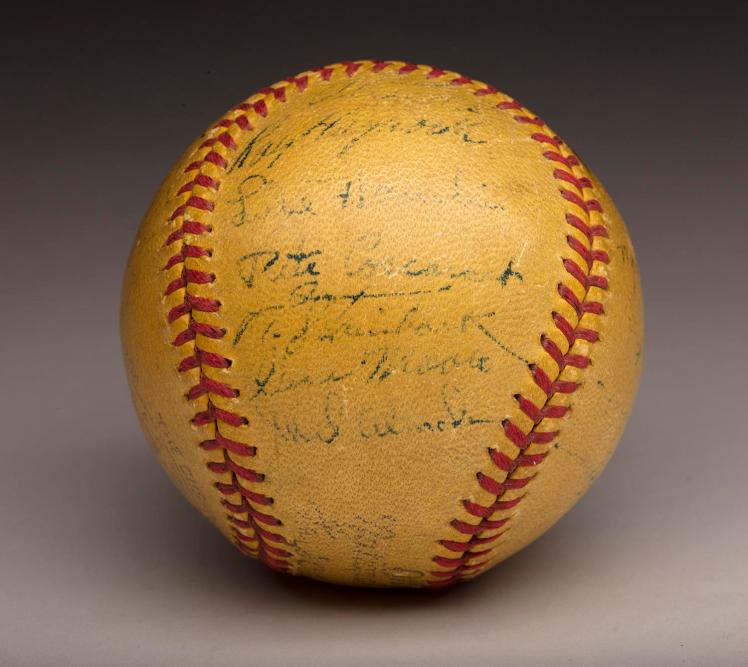
For the first game of a doubleheader played on August 2, 1938, Larry MacPhail had official baseballs dyed dandelion yellow, and the balls were used in the matchup between the Dodgers and Cardinals at Ebbets Field. The inspiration for this yellow ball came from a New York color engineer named Frederic H. Rahr, who developed it after Mickey Cochrane was severely beaned at the plate the previous year.
“My primary object is to give the hitter more safety and there’s no question that this will be achieved,” said Rahr. “That’s simply because the batter will be striking at a ball he can see instead of at a white object that blurs with the background.”
The Dodgers won that opening game with the yellow baseballs by a score of 6-2. The Dodgers went on to use up their yellow balls in three more games in 1939, but the yellow balls would not get used again after that season.
Slim Sallee became the first pitcher in Cardinal history to steal home on July 22, 1913 in a game against the Brooklyn Superbas. The Redbird lefty performed the feat in the game’s third inning, scoring the first run in St. Louis’s 3-1 victory over Brooklyn at Ebbets Field.