“The Man Into Whose Yard You Should Not Hit Your Ball,” by Thomas Lux

I have known folks who mow their lawn this way.  Pine cones?  Run ’em over.  Thick coatings of leaves?  The mower can handle it.  Rocks?  Who cares if they go flying?

I don’t mow that way 1) because I don’t have the money to buy a new lawn mower every other month, and 2) because I learned in a most unfortunate manner what happens when the mower picks up a stray rock and sends it flying into a window.

Running over a baseball would surely wreak havoc on any mower, no manner how sturdy and well-built it may be.  And any mower would wreak just as much havoc on the poor baseball.

*

each day mowed
and mowed his lawn, his dry quarter acre,
the machine slicing a wisp
from each blade’s tip.
Dust storms rose
around the roar: 6:00 P.
M.
, every day,
spring, summer, fall.
If he could mow
the snow he would.

On one side, his neighbors the cows
turned their backs to him
and did what they do to the grass.

Where he worked, I don’t know
but it sets his jaw to: tight.

His wife a cipher, shoebox tissue,
a shattered apron.
As if
into her head he drove a wedge of shale.

Years later his daughter goes to jail.

Mow, mow, mow his lawn
gently down a decade’s summers.

On his other side lived mine and me,
across a narrow pasture, often fallow;
a field of fly balls, the best part of childhood
and baseball, but one could not cross his line
and if it did,
as one did in 1956
and another in 1958,
it came back coleslaw — his lawn mower
ate it up, happy
to cut something, no matter
what the manual said
about foreign objects,
stones, or sticks.

Books and movies and lists

Over the course of the last week, I’ve compiled a couple of different lists, both now live on my site.  One is a list of books, the other a list of documentaries and movies.

There isn’t any actual new information on either page.  Mostly I thought it would be nice to have a centralized location that I, and potentially others, can reference.  I’m the kind of person who will occasionally do a web search for various lists of books or other sorts of media in order to get ideas, and I imagine there are others out there who must do the same.  In the process of creating these lists, I’m noticed there are a number of movies that I’ve yet to write about here, so that’ll be a nice little project for me to get on.

Feel free to check the pages out, share them with others, or ignore them completely.

Booklist: https://archivedinnings.com/baseball-books/

Film list: https://archivedinnings.com/baseball-on-film/

No automatic alt text available.

Last of the Third, by John Lindholm

This weekend I finished reading Last of the Third by John Lindholm.  I hadn’t heard of the book prior to coming across it, but the summary sounded fascinating — and, of course, it’s about baseball — so I figured I’d give it a shot.

The novel’s main character, twenty-two-year-old Shawn McMaster, used to play baseball in his home town of Quail, Pennsylvania as their star left fielder.  Shawn was a brilliant fielder, but really just an average hitter, and his performance at the plate caused him no small amount of anxiety.  As the story opens, however, the reader quickly realizes that Shawn is in hiding, and we further learn that he hasn’t been home, nor played baseball, in four years.  Shawn’s reason for going into hiding remains a mystery for much of the book, as Lindholm reveals that detail of the story inch-by-excruciating-inch over the course of the novel.lindholm

One night, Shawn’s whereabouts happen to get discovered by Larry Schneider, better known in Quail as Larry Last, the town oddball and best friend to Shawn’s grandfather, DJ McMaster.  Larry relays the details of Shawn’s location to Shawn’s parents, and Shawn’s mother, Greta, convinces her son to return home at last.

Things are awkward, of course.  While things in Quail don’t seem to have changed on the surface, Shawn soon realizes that his disappearance has had a profound impact on his parents, his friends, and his girlfriend, CeCe.  He continues to struggle with his own self-deprecation, however, and it’s not until his father’s sudden, unexpected death that Shawn finally pulls his head out of his self-loathing and realizes that it’s time to take some responsibility for himself and those he cares about.

Meanwhile, the McMaster property in Quail is in trouble.  Larry Last, who was with DJ McMaster in his last moments alive, has a couple of clues on how to save the property, but he is struggling to make sense of them.  Lindholm does a fantastic job of dropping enough hints to keep the reader puzzling over the mystery, but not so many as to make it easily solvable.  When the solution finally presented itself, I had to tip my hat to the author for his cleverness.

The plot does not follow a linear timeline, but rather jumps back and forth between the novel’s present events and flashing back to those events that brought the characters to where they now stood.  I like the general structure of utilizing flashbacks in a story like this, though at times I found myself wishing it didn’t happen quite as often in this book.  Most of the chapters are short, and most chapters take place in a different point in time, and so I found myself constantly having to refer back to the dates at the start of each chapter in order to orient myself.  I certainly wouldn’t change the structure so much as just combine some of the shorter chapters into longer ones.

I have to confess, there were several instances while reading when I grew quite irritated with both Shawn McMaster and with his girlfriend CeCe.  Then it occurred to me, about halfway through the novel, that my irritation with these two characters mirrored my irritation with the college-aged folk whom I deal with on a regular basis.  That being said, I came to realize that Lindholm’s character development with regards to these two was actually spot on, and that my frustrations were not due to bad writing, but to really good character portrayal.  I’m sure that sounds like a rather convoluted reaction, and it probably is.  But it makes sense to my own mind, anyways.

Overall, I enjoyed the book.  It is nice, for a change, to have an outfielder be the star of the baseball team, rather than a pitcher or a shortstop or the team’s slugger.  It’s definitely a coming-of-age story, though it’s one that happens in an older age group than usually seen in literature.  Last of the Third takes the familiarity of baseball, small towns, and pie, and adds a couple of interesting twists to make it unique.

Deadball, by David B. Stinson

This weekend I finished reading Deadball: A Metaphysical Baseball Novel by David B. Stinson.  I stumbled upon this book accidentally, actually while looking for another book (I can no longer recall which) about the Dead Ball Era.  Stinson’s novel is not about the era — not really, anyways.  Rather, this novel is somewhat Field of Dreams-esque in that the book’s main character finds himself seeing the ghosts of long gone ballplayers and sometimes even the old ballparks they used to play in, but which have long since been abandoned or torn down.

The protagonist of this novel is one Byron deadballBennett, a.k.a. “Bitty,” though he despises the nickname.  Byron is a former minor league ballplayer who never made it past the AAA level, but continues to stay obsessed with baseball and with baseball history.  As a kid, Byron once saw the deceased Babe Ruth hit a home run at a local ballpark.  Upon crossing home plate, Ruth winked at Byron, then disappeared.  Byron’s parents and friends dismissed the experience as Byron’s imagination.  Years later, Byron now finds himself having additional, similar experiences.
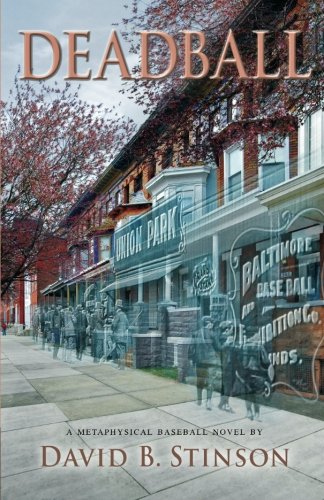
The year is now 1999, and Byron works for the minor league Bowie Baysox, an affiliate of his favorite MLB team, the Baltimore Orioles.  In his spare time, Byron not only goes to Orioles games, he also steeps himself in baseball history.  1999 represents the final year for baseball in Detroit’s Tiger Stadium, and with that in mind, Byron decides to travel to Detroit for the Orioles’ final series in that stadium.  He meets an older gentleman who calls himself Mac, though Byron suspects there is more to Mac than meets the eye.  For one thing, the bar where Byron meets Mac has been shut down and boarded up for years, as confirmed by the locals, though it certainly didn’t appear that way when Byron first came across it.

Byron’s road trip brings him not only to Detroit, but he also stops at the former site of Forbes Field, and he stops in Cleveland on his return trip.  Byron comes across a number of other characters, all who, like Mac, don’t seem like your normal, everyday humans-on-the-street.  Byron goes on various road trips throughout the season, visiting old ballpark sites in New York and Boston, and even stopping in graveyards to pay his respects to old ballplayers.  On his travels, Byron carries with him a copy of Lawrence Ritter’s Lost Ballparks, which he references whenever he finds himself in the presence of one of the old time baseball fields.  On occasion, the ballparks seem to come alive in his presence, and he starts to look forward to the occurrence.  Byron also has an encyclopedic familiarity with old ballplayers, and he is stunned to realize that the strange gentlemen he is meeting in his travels are all former, and now-deceased, ballplayers.

Byron’s friends, boss, and ex-wife are all concerned about him, of course.  They tell him it is time to stop living in the past and to let go of baseball so he can move on with his life.  The word “crazy” is thrown around liberally, and Byron sometimes even wonders himself.  He doesn’t understand how it is he is seeing these things, nor why.  In addition to the ghosts he comes across, Byron also meets a man named Peter, who is President of the Cleveland Spiders Historical Society and is very much alive.  Peter recognizes Byron’s ability to see old players and old ballparks, because he sees them as well.  However, Peter warns that he has known others like them, and those others no longer have any memory of ever having these visions.  Byron, in spite of his concerns about his own sanity, worries that he, too, will lose the ability to see the old ballparks.

Much of the novel is spent in the details of Byron’s exploration: descriptions of the ballparks, of the cities in which they are located, down to street-by-street directions at times.  These details sometimes border on tedious, but all the same, I had to admire their inclusion, as it makes it clear that the author, Stinson, has experienced these locations himself and is now gracious enough to share them with us.  The reader also doesn’t learn about the purpose behind Byron’s odyssey literally until the very, very end of the novel, which concerned me as I started to run out of pages and the resolution seemed nowhere in sight.  But a resolution does come, and it is a fascinating one.

I suppose I shouldn’t speak to the experience as just any casual reader, but as a baseball fan I thoroughly enjoyed this book.  The pages go by quickly, and I found myself immersed in the details, the characters, and in Byron’s knowledge of baseball.  The descriptions of the ballparks Byron was able to see even made me jealous, wishing that I could be in Byron’s shoes, seeing these ballparks myself, rather than just reading about them.  If you get the opportunity, I highly recommend this one.

“When Father Played Baseball,” by Edgar Albert Guest

When I first started reading this poem by Edgar Guest, the first stanza gave me the impression that this would be about a man who used baseball as an analogy through which to teach his children important lessons about life.  Boy, was I wrong.  As I read on, I found myself smiling a bit, and even had to chuckle by the end.

Enjoy.

*

The smell of arnica is strong,
And mother’s time is spent
In rubbing father’s arms and back
With burning liniment.
The house is like a druggist’s shop;
Strong odors fill the hall,
And day and night we hear him groan,
Since father played baseball.

He’s forty past, but he declared
That he was young as ever;
And in his youth, he said, he was
A baseball player clever.
So when the business men arranged
A game, they came to call
On dad and asked him if he thought
That he could play baseball.

“I haven’t played in fifteen years,
Said father, “but I know
That I can stop the grounders hot,
And I can make the throw.
I used to play a corking game;
The curves, I know them all;
And you can count on me, you bet,
To join your game of ball.”

On Saturday the game was played,
And all of us were there;
Dad borrowed an old uniform,
That Casey used to wear.
He paid three dollars for a glove,
Wore spikes to save a fall
He had the make-up on all right,
When father played baseball.

At second base they stationed him;
A liner came his way;
Dad tried to stop it with his knee,
And missed a double play.
He threw into the bleachers twice,
He let a pop fly fall;
Oh, we were all ashamed of him,
When father played baseball.

He tried to run, but tripped and fell,
He tried to take a throw;
It put three fingers out of joint,
And father let it go.
He stopped a grounder with his face;
Was spiked, nor was that all;
It looked to us like suicide,
When father played baseball.

At last he limped away, and now
He suffers in disgrace;
His arms are bathed in liniment;
Court plaster hides his face.
He says his back is breaking, and
His legs won’t move at all;
It made a wreck of father when
He tried to play baseball.

The smell of arnica abounds;
He hobbles with a cane;
A row of blisters mar his hands;
He is in constant pain.
But lame and weak as father is,
He swears he’ll lick us all
If we dare even speak about
The day he played baseball.

Quote of the day

It [baseball] will take our people out-of-doors, fill them with oxygen, give them a larger physical stoicism. Tend to relieve us from being a nervous, dyspeptic set. Repair these losses, and be a blessing to us.

~Walt Whitman

Walt Whitman, July 1854 (Morgan Library & Museum/public domain)

‘The Great American Novel,’ by Philip Roth

A few weeks ago, I finished Philip Roth’s The Great American Novel.  It pains me that it’s taken this long to get around to writing about it, but work and school assignments took priority.  But the end of the semester brings with it a little extra time — for a little while, at least.

Going into this book, I knew that baseball was a huge part of the plot, but I never expected the satire and the hilarity that

Amazon
Amazon

ensued throughout the novel.  The book, which takes place during the 1940s, revolves around the Ruppert Mundys, a baseball team in the long-forgotten Patriot League.  The narrator, “Word” Smith (a.k.a. “Smitty”), once traveled with the team writing columns about its exploits, and now remains the only person in modern-day America who remembers anything about them.  All memory of the Patriot League, once the third Major League, has vanished from the American consciousness in a convoluted mess of a communist conspiracy.  The Ruppert Mundys, who had no real home ballpark as a result of the war effort, were the Patriot League’s worst team — a mishmash of eccentric players, from a fourteen-year-old second baseman to a one-armed outfielder to a midget pitcher.

Throughout its history, the Mundys also produced its share of memorable players.  Gil Gamesh, for example, is a pitcher destined to break records all around Major League Baseball.  He was also the only player who ever literally tried to kill the umpire.  Roland Agni, meanwhile, is a .370 hitter and a perfect physical specimen with a tremendous conscience.

Over the course of the 1943 season, the Mundys manage to lose 120 of 154 games.  The one bright spot in their otherwise-disastrous season is an eleven-game winning streak fueled by Wheaties, which were altered by a Jewish teenage genius who bet on the team surreptitiously.  By the end of the tale, we learn that the entirety of the Patriot League has been infiltrated by communists.  Following an investigation and series of trials by the House Un-American Activities Committee, the league is dissolved and soon-forgotten.

All in all, the novel proves itself to be funny and crass — I literally laughed out loud at various points — and certainly not grade school reading material.  Nevertheless, Roth’s prose is infiltrating, poetic, and engaging, revealing his ability to turn a phrase just as easily as he can crack a misogynistic or racist joke.  This is not to call Roth a bigot.  If anything, his writing plays off and reveals the true inner thoughts and perceptions of the average American male during the time period in which the novel takes place.

More importantly, the book reveals in no uncertain terms that Roth knows baseball.  He describes the game with a fluency worthy of a baseball historian, and he does so in an intriguingly witty fashion.  The Great American Novel may not necessarily live up to the title as being the “great American novel” compared to, say, Huckleberry Finn, but it does merit at least a read-through by baseball’s fans.

“In Baseball,” by Baron Wormser

I  really like the style of this piece by Baron Wormser.  It makes me think of the great ancient war tales — almost Homer-ish or Virgil-esque, in its own way.

*

Neither forces nor bodies equivocate:
Each action holds a tell-tale trait,
Each moment convokes an actual fate.

Reality, being precious, becomes a game
In which, nature-like, no two things are the same–
Whatever is remarkable is nicknamed.

The untitled fan applauds the grace of epithet
And thinks of warring Greeks, whose threats,
Stratagems, confusions, deeds though met

On a smaller scale are yet quiveringly real.
Player against player on a simple field,
It’s the keenness of conflict that appeals

To the citizen so sick of the abstract “they.”
Here, there is no such thing as a beggared day.
Achievement can be neither created nor feigned

And the whole mix of instinct, confidence, wit,
And strength emerges as a catch or a hit,
Something indicative, legible, quick

And yet as much a mystery as luck.
Lured by the tangible we strive to pluck
The meaning that cannot be awe-struck.

The exemplary fact remains–a ball,
The thing that rises and abjectly falls,
The unpredictable, adroit rhyme of it all.

“Game Called,” by Grantland Rice

I stumbled across this piece last night and fell in love with it instantly.  Grantland Rice, the man who wrote “Casey’s Revenge,” wrote this poem in 1910.  This is titled “Game Called,” and it captures the aftermath of a hard-played ballgame with beautiful metaphor and imagery.

*

Game Called.
Across the field of play
the dusk has come, the hour is late.
The fight is done and lost or won,
the player files out through the gate.
The tumult dies, the cheer is hushed,
the stands are bare, the park is still.
But through the night there shines the light,
home beyond the silent hill.

Game Called.
Where in the golden light
the bugle rolled the reveille.
The shadows creep where night falls deep,
and taps has called the end of play.
The game is done, the score is in,
the final cheer and jeer have passed.
But in the night, beyond the fight,
the player finds his rest at last.

Game Called.
Upon the field of life
the darkness gathers far and wide,
the dream is done, the score is spun
that stands forever in the guide.
Nor victory, nor yet defeat
is chalked against the players name.
But down the roll, the final scroll,
shows only how he played the game.

“The Man Who Fanned Casey,” by T.M. Fowler

Now here’s a great twist on Casey At the Bat, written from the point-of-view of a fan with a focus on the pitcher.  There are, after all, two teams on the field, and the opposition has a perspective that is just as fascinating.  Published in 1907, “The Man Who Fanned Casey” first appeared in the Waterloo (Iowa) Daily Courier, written by T.M. Fowler.

*

I’m just an ordinary fan, and I don’t count for much,
But I’m for writing history with a true and honest touch.
It isn’t often that I knock – I’ll put you next to that –
But I must interpose a word on Casey at the Bat.

Oh, yes, I must admit it; the poem is a beaut.
Been runnin’ through my thinker since our team got the chute.
I heard an actor fan recite it thirteen years ago;
He sort of introduced it in the progress of the show.

It made a hit from gallery, down to the parquet floor;
But now I’ve got to thinking, and that poem makes me sore.
I’d like to know why any fan should be so off his nut
About the Mighty Casey who proved himself a mutt.

The score, we’re told, stood four to two, one inning left to play.
The Frogtown twirler thought he had things pretty much his way,
So in the ninth, with two men down, he loosened up a bit;
And Flynn scratched out a single, Blake let loose a two-base hit.

Then from the stand and bleachers there arose a mighty roar.
They wanted just that little hit they knew would tie the score.
And there at the bat was Casey, Mighty Casey, Mudville’s pride;
But was the Frogtown slabster sent balloonin’, terrified?

Now in the ninth, with two men down and Casey at the bat,
Most pitchers would have let him walk – we all are sure of that.
But Hagen was a hero, he was made of sterner stuff;
It’s his kind who gets the medals and the long newspaper puff.

He knew the time had come for him to play a winning role.
He heard the fans a-yelling; it was music to his soul.
He saw the gleam of confidence in Mighty Casey’s eye.
“I’ll strike him out!” Hagen resolved. “I’ll do it or I’ll die!”

He stood alone and friendless in that wild and frenzied throng.
There wasn’t even one kind word to boost his game along.
But back in Frogtown where they got the plays by special wire
The fans stood ready, if he won, to set the town on fire.

Now Hagen twirls his body on the truest corkscrew plan
And hurls a swift inshoot that cuts the corner of the pan.
But Casey thought the first ball pitched would surely be a ball,
And didn’t try to strike it, to the great disgust of all.

Again the Frogtown twirler figures dope on Mudville’s pride;
And Casey things the next will be an outshoot breaking wide.
But Hagen shot a straight one down the middle of the plate,
And Casey waited for a curve until it was too late.

A now the mighty slugger is a-hangin’ on the string.
If another good one comes along, it’s up to him to swing.
The jaunty smile, Hagen observed, has faded from his face,
And a look of straining agony is there to takes its place.

One moment Hagen pauses, hides the ball behind his glove,
And then he drives it from him with a sweeping long arm shove.
And now the air is shattered, and the ball’s in the catcher’s mitt,
For Casey, Might Casey, hadn’t figured on the spit!