Quote of the day

Every day is a new opportunity. You can build on yesterday’s success or put its failures behind and start over again. That’s the way life is, with a new game every day, and that’s the way baseball is.

~Bob Feller

Slug the Umpire

Here’s a poem that was originally printed in the Chicago Tribune in 1886, reprinted in Harvey Frommer’s Old-Time Baseball. I found the piece quite amusing, and I’m sure we have all had those moments when we could relate to the writer’s request.  Enjoy!

*

Mother, may I slug the umpire
May I slug him right away?
So he cannot be here, Mother,
When the clubs begin to play?

Let me clasp his throat, dear mother,
In a delightful grip
With one hand and with the other
Bat him several in the lip.

Let me climb his frame, dear mother,
While the happy people shout;
I’ll not kill him, dearest mother,
I will only knock him out.

Let me mop the ground up, Mother,
With his person, dearest do;
If the ground can stand it, Mother,
I don’t see why you can’t, too.

Mother, may I slug the umpire,
Slug him right between the eyes?
If you let me do it, Mother,
You shall have the champion prize

–Untitled (Slug the Umpire)
by Anonymous

If only St. Patrick could have played baseball

Credit: MLB.com

Happy St. Patrick’s Day!

In celebration of the holiday, you can probably anticipate tuning in to see some of your favorite MLB teams donning a little bit more green than just the usual grass stains.  Green uniforms, green bases, green catcher’s gear, and fans who resemble over-sized leprechauns.    It’s a lot of fun for us to watch today, but when it first started in 1978, it was a bit of a shock.

Prior to spring training that year, Cincinnati Reds general manager Dick Wagner put in a secret order for green uniforms for his team.  On March 17th, the Reds were slated to face the New York Yankees at Al Lopez Field in Tampa Bay, Florida.  Upon completing their pre-game routines, Reds players returned to the locker room, and were stunned to find green uniforms hanging at each of their lockers.

“Did we get traded to Oakland?” joked catcher Johnny Bench.

Shortstop Davey Concepcion, however, was not amused.  “I’m not wearing that,” he insisted.  “I’m Venezuelan, not Irish.”

But the club quickly conceded, and when the Reds marched out onto the field in green uniforms, it created quite a stir.

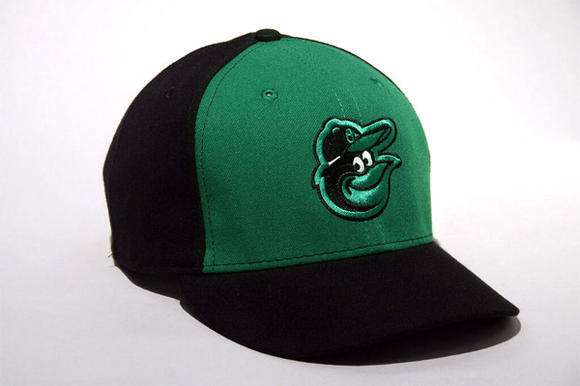
Wagner’s publicity stunt quickly became a tradition, as other Major League clubs began to don green on St. Patrick’s Day in the years that followed.  And it didn’t just stop at baseball.  NBA teams have adopted the practice with their own green uniforms, and NHL teams have been known to wear green practice jerseys while warming up prior to games.  This year, the Baltimore Orioles have announced that fans can keep an eye out for this cap:

Credit: UniWatch, Paul Lukas, via Twitter

Personally, I’d rather just carry a four-leaf clover in my pocket for good luck, but admittedly, the tradition is pretty fun in its own right.  Here’s a toast (with green beer!) to baseball and to looking a little ridiculous on this fine holiday.

————————————————————

Sources:

Lukas, Paul.  “UniWatch: Time for green gimmick to go?”  ESPN.com.  ESPN Internet Ventures, 15 March 2013.  Web.  Accessed 17 March 2013.  http://espn.go.com/blog/playbook/fandom/post/_/id/19646/uni-watch-time-for-green-gimmick-to-go

Newman, Mark.  “Major League Baseball going green on St. Patrick’s Day.”  MLB.com.  MLB Advanced Media, LP, 17 March 2011.  Web.  Accessed 17 March 2013.  http://mlb.mlb.com/news/article.jsp?ymd=20110317&content_id=16988026&vkey=news_mlb&c_id=mlb

Singer, Tom.  “How St. Patrick’s Day became baseball’s holiday: Cincy GM Dick Wagner turned the Reds green in ’78.”  MLB.com.  MLB Advanced Media, LP, 17 March 2010.  Web.  Accessed 17 March 2013.  http://mlb.mlb.com/news/article.jsp?ymd=20100316&content_id=8811150&vkey=news_mlb&fext=.jsp&c_id=mlb


This day in baseball history: The Flying Dutchman

Source: http://www.honuswagner.com


On 16 March 1908, legendary Pirates shortstop Honus Wagner announced that he was going to retire (again) at the conclusion of the season.  That year, the man known as the “Flying Dutchman” led the National League in batting average, hits, total bases, doubles, triples, RBIs, and stolen bases.  He came only two home runs short of winning the Triple Crown.

Wagner did not retire at the end of the season, however, and continued to play in the MLB until 1917.  Following retirement as a player, Wagner served as a coach with the Pirates until the 1950s.  He was inducted into the Hall of Fame in 1936.

All over a little bit of pine tar

“Obviously I disagreed with the call, so I calmly went out there to question them.” – George Brett

The famous Pine Tar incident, July 24, 1983 at Yankee Stadium.  The video does a sufficient job of showcasing and explaining the event itself, so I won’t waste your time by reiterating it here.

But what is pine tar?  Of what use is it to a baseball player?

Pine tar is a sticky material derived from the roots and stump of pine trees.  When it was first created in Sweden, ropes and wooden ships were coated with it for the sake of waterproofing and preservation.  When used on a baseball bat, pine tar creates a texture that makes it easier to grip the bat and prevents it from slipping from the player’s hands in the hot, humid weather.  It also allows a hitter to get more “pop” out of the bat without having to utilize a death grip on the handle.  But does it really give a batter an advantage when it comes to hitting a baseball?  According to former American League President Lee MacPhail: no, it doesn’t.

In 1983, according to Official Playing Rule 6.06(a), “a batter is out for illegal action when he hits an illegally batted ball.”  And according to Rule 1.10(b), a bat “treated with any material [including pine tar] … which extends past the 18 inch limitation … shall cause the bat to be removed from the game.”  It was by combining these two rules that the umpires decided to rule the play an out.

In the case of George Brett, MacPhail overrode the call because the rule had more to do with economics than with any potential competitive advantage.  As he states in the video, “Pine tar didn’t help that ball that Brett hit go out of the ballpark.”  However, if pine tar gets on a baseball, it renders the ball unfit for continued use in a Major League game.  MacPhail argued that while the ruling was “technically defensible, [it] is not in accord with the intent or spirit of the rules. […]  The rules provide instead that the bat be removed from the game.  The protest of the Kansas City Club is therefore upheld and the home run by Brett is therefore permitted to stand.”  The rule has since been revised in the spirit of this interpretation and clearly states today that since no objection was made to Brett’s use of the bat prior to his hitting the home run, the play stood.

According to the official rule book of 2012:

Rule 1.10(c) Comment: If pine tar extends past the 18-inch limitation, then the umpire, on
his own initiative or if alerted by the opposing team, shall order the batter to use a different bat. The batter may use the bat later in the game only if the excess substance is removed. If no objections are raised prior to a bat’s use, then a violation of Rule 1.10(c) on that play does not nullify any action or play on the field and no protests of such play shall be allowed.

The image of George Brett charging out of the dugout, arms flailing, is one that no doubt will stand the test of time.  As New York’s Don Mattingly described it, “The sight of George coming out of the dugout is etched in my mind forever.  That roar symbolizes the way he plays the game, the kind of fire he has.”  Makes me wish I could have been there to see it in person.

Box scores for the game can be found here: http://www.retrosheet.org/boxesetc/1983/B07240NYA1983.htm

—————————————————————————

Sources:

“2012 Edition: Official Baseball Rules.”  MLB.com.  Commissioner of Baseball, 2011.  Web.  Accessed 13 March 2013.  http://mlb.mlb.com/mlb/downloads/y2012/Official_Baseball_Rules.pdf

Hoefs, Jeremy.  “What Is Baseball Pine Tar?”  Livestrong.com.  Demand Media, Inc., 23 Mar 2010.  Web.  Accessed 13 March 2013.  http://www.livestrong.com/article/84132-baseball-pine-tar/

“Royals Hall of Fame Photo Galleries: The Pine Tar Game.”  MLB.com.  MLB Advanced Media LP, 2001-2013.  Web.  Accessed 13 March 2013.  http://kansascity.royals.mlb.com/photos/gallery.jsp?content_id=27838192&c_id=kc

This day in baseball: Aaron replaces Thomson

On 13 March 1954, Braves outfielder Bobby Thomson broke his ankle sliding into third base during an exhibition game against the Pirates.  Unfortunately for Thomson, this meant that he was out of the lineup until July 14.  Fortunately for baseball history, this event opened up a starting spot for a young man named Hank Aaron.  Nobody’s ever heard of him, have they?

“As far as I’m concerned, (Hank) Aaron is the best ball player of my era. He is to baseball of the last 15 years what Joe DiMaggio was before him. He’s never received the credit he’s due.” – Mickey Mantle in Baseball Digest (June 1970)

A trip around the bases

Here’s a fun video I came across, depicting a collage of photos taken over the course of baseball history.  Unfortunately, there is no dialogue and only a limited number of captions to explain what is going on in each image, but many faces and moments are nonetheless recognizable.  The evolution of uniforms and equipment can also be seen here.  A great slideshow played against a backdrop of great music, Pink Floyd‘s “Us and Them.”

Thanks to libertyman24 for posting this on YouTube.

The girls of summer

“There’s no crying in baseball!”

Thanks to the 1992 comedy-drama, A League of Their Own, how many of us have not heard this classic line?  The movie dramatizes for us the story of the All-American Girls Professional Baseball League.  When World War II broke out, and many of the men in Major League baseball were called to away to serve, the prosperity of professional baseball was threatened.  In order to keep the sport alive (and to salvage some lost profits), baseball owners created the AAGPBL, scouted women players across the country, dressed them in skirts, and sent them out to play ball.

However, women’s involvement in baseball existed long before World War II.  In New York and New England, baseball was being played in women’s colleges as early as the mid-nineteenth century.  In 1867, Philadelphia played host to an African-American women’s team, the Dolly Vardens.  One great story you might have heard involves Jackie Mitchell of the Chattanooga Lookouts.  As a pitcher during an exhibition game in the 1930s, Mitchell struck out both Babe Ruth and Lou Gehrig.  Unfortunately, this event was quickly promoted as a mere publicity stunt, rather than a serious effort on the parts of Ruth and Gehrig.

Today, there persists a distinction between baseball as a male’s game and softball as a female’s game, but this separation did not exist until the 1890s when softball was invented.  For three decades prior to this, however, women played baseball, even as baseball leaders like Albert Spalding promoted it as a “manly” or “gentleman’s” game.  No doubt they looked ridiculous, as the uniforms of college women ballplayers consisted of baseball caps and full-length dresses, but women loved playing the game and they proved themselves to be just as competitive and physical as their male counterparts.  Unfortunately, society considered it too strenuous and unhealthy for women to engage in too much travel or competition, and as a result, women’s college baseball was confined to existing as an intramural sport, rather than an intercollegiate one.  As a result of the sexism of the period, from males and females alike, women’s attempts to establish themselves in baseball were doomed to failure.

As fans, however, the presence of women at baseball games was often encouraged.  It was believed that the presence of women would help to discourage the fighting and cat-calling that sometimes happened at the ballpark.  In the late-nineteenth century, Ladies’ Day promotions came into being, in an attempt to attract women fans to games.  By 1900, middle-class women were attending ballgames throughout the country.  In 1909, the National League, convinced that women had become sufficiently interested in the game to start paying for admission, brought an end to the Ladies’ Day promotion.

While the creation of the All-American Girls Professional Baseball League was certainly a breakthrough for women in the sport, baseball owners made it clear that the league was only temporary, and there was to be no question that those who played were women first and baseball players second.  From the short skirts and team names to the mandatory chaperones and strict rules on the women’s behavior, every measure was taken to reassure the public and the girls’ families that their femininity would remain intact.

The sport of softball continues to flourish today, but questions continue to circulate about its impact in perpetuating sexist stereotypes.  The common belief is that due to the physical differences between men and women, confining them to separate sports helps to maintain a fair playing field and protects women from needless injuries.  But when you think about it, baseball is a game that requires coordination, timing, knowledge of the game, control, and competitiveness — all characteristics that are not exclusively male.  Sure, perhaps strength and size can be useful assets, but even male players like Ichiro Suzuki have proven that they are not absolute essentials to being successful ballplayers.  And I know from personal experience that, out of the playing field, girls can be just as brutal and ruthless as the guys, if not more so.  After all, baseball is considered to be “America’s Pastime,” and as the AAGPBL Victory song points out, “we’re All-Americans” too.

Sources:

“A League of Their Own.”  The Internet Movie Database (IMDb).  IMDb.com, Inc., 1990-2013.  Web.  Accessed 11 March 2013.  http://www.imdb.com/title/tt0104694/

Frommer, Harvey.  Old-Time Baseball: America’s Pastime in the Gilded Age.  Lanham: Taylor Trade Publishing, 2006.

Gems, Gerald, Linda Borish, and Gertrud Pfister. Sports in American History: From Colonization to Globalization. Human Kinetics, 2008.

Heaphy, Leslie.  “Women Playing Hardball.”  Baseball and Philosophy: Thinking Outside the Batter’s Box.  Ed. Eric Bronson.  Chicago: Open Court, 2004.  pp. 246-256.

Riess, Steven A.  Touching Base: Professional Baseball and American Culture in the Progressive Era.  Westport, Connecticut: Greenwood P, 1980.

Ring, Jennifer.  Stolen Bases: Why American Girls Don’t Play Baseball.  U of Illinois P, 2009.