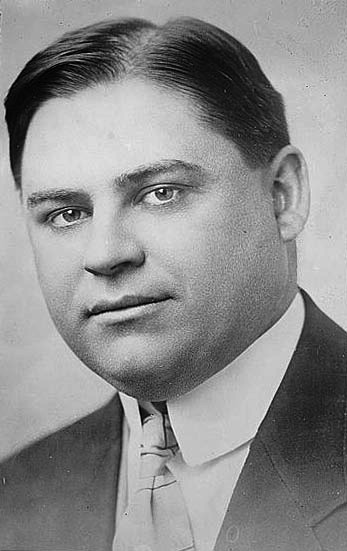
“Thank you ladies and gentlemen. I hope some day that some of the young fellows coming into the game will know how it feels to be picked in the Hall of Fame. I know the old boys back in there were just talking it over, some have been here long before my time. They got on it, I worked hard, and I got on it. And I hope that the coming generation, the young boys today, that they’ll work hard and also be on it.
And as my old friend Cy Young says, “I hope it goes another hundred years and the next hundred years will be the greatest. You know to me this is just like an anniversary myself, because twenty-five years ago yesterday I pitched my first baseball game in Boston, for the Boston Red Sox. (applause)
So it seems like an anniversary for me too, and I’m surely glad and it’s a pleasure for me to come up here and be picked also in the Hall of Fame. Thank you.”
On August 17, 1948, one day after Babe Ruth’s death, Yankee Tommy Henrich launched his fourth grand slam for the season, thus tying one of Ruth’s records. Ruth’s body, which was on display at Yankee Stadium, received visits from approximately 100,000 fans. The Great Bambino was buried at the Cemetery of the Gate of Heaven in Hawthorne, New York two days later.
In a game against the Washington Senators on June 23, 1917, Boston pitcher Babe Ruth angrily charged umpire Brick Owens after Owens called ball four for the first batter of the game. Ruth was ejected from the game, his teammates dragging him from the field. Ernie Shore came into the game in relief and proceeded to set down the next 26 hitters. The only hitter to get on base — Ruth’s walk — was caught trying to steal second.
On June 10, 1921, Babe Ruth of the New York Yankees jacked his 120th career home run while facing Indians pitcher Jim Bagby. With this homer, Ruth became baseball’s all-time career home run leader — a position he would hold until 1974, when Hank Aaron hit his 715th round tripper.
On May 20, 1919, Red Sox pitcher Babe Ruth hit the first grand slam of his career as the Sox defeated the Browns 6-4 at Sportsman’s Park in St. Louis. The Babe would go on to hit sixteen bases loaded round trippers over the course of his career.
The Dead Ball Era, as the name suggests, was a period in baseball history characterized by low-scoring games and a lack of home runs. This age in baseball began in 1900 and lasted until Babe Ruth came onto the scene as a power hitter in 1919. Prior to Ruth, the game was more strategy-driven, featuring hit-and-run plays and base-stealing over hitting for power. In 1908, the lowest-scoring year, teams averaged only 3.4 runs per game. “Small ball,” as it’s known today, relied more on speed and quickness than on brute strength. Players like “Smoky” Joe Wood, Eddie Collins, and Sam Crawford flourished during this time.
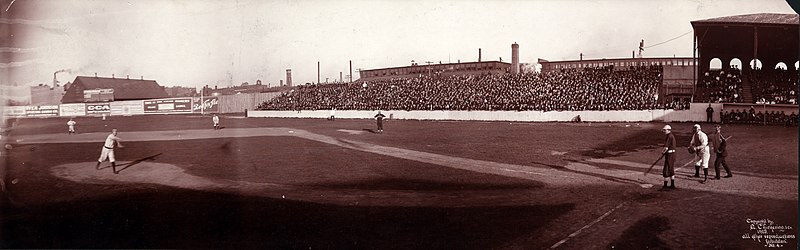
Many baseball fields of the age were much larger than modern ballparks. Chicago’s West Side Grounds, for example, measured 560 feet to the center field fence. Huntington Avenue Grounds in Boston measured 635 feet to the center field fence. By comparison, most ballparks today don’t measure much more than the requisite 400 feet to dead center, which makes a huge difference for a player’s ability to swing for the fences.
Huntington Avenue Grounds (Wikimedia Commons)
The state of the baseball throughout the game also contributed to the lack of home runs. The same ball was used throughout the game — unlike today, when even a tiny smudge on a ball calls for a new replacement. As the game would go on, the ball would become dirtier and dirtier, making it more difficult for hitters to see and hit. No doubt the extra dirt also contributed to the dynamics of the baseball’s movement.
Speaking of which, during the Dead Ball Era, pitcher could still legally throw a spitball. “Doctoring” the baseball in this way would alter the physics of the flight of the pitch, causing it to break or move in unexpected ways and making it more difficult to hit. Naturally, pitchers took advantage of this concession. And it wasn’t just the spitball: the emery ball, shine ball, mud ball, so on and so forth. Got any creative ideas for defacing a baseball? Give it a whirl and see what it does! The umpires won’t stop you.
On top of low-scoring contests, during these years, professional baseball also experienced turbulence through the births of baseball organizations outside of the National League. In 1900, the American League, which had been a minor league prior to this year, declared itself a Major League. Refusing to continuing recognition of the terms of the National Agreement, the AL now moved teams into cities already claimed by the NL, such as Philadelphia, Boston, and Baltimore. By 1902, the NL realized it would be better off accepting the American League, rather than fighting against it. A three-man National Commission was created to resolve the disagreements between the two leagues. Major League Baseball prospered and the World Series was born.
The birth of the Federal League in 1913 threatened this new-found prosperity. It launched an anti-trust lawsuit against the AL and the NL, which drained the two leagues of resources. Like the AL before it, the FL moved into already-established Major League territory, seeking to carve out its own place in Major League Baseball. In the end, however, the level of play in the FL did not match that of the other two leagues, and FL teams merged into the other Major Leagues.
The outbreak of World War I also proved detrimental to baseball. Baseball became viewed as a frivolous, non-essential activity, and seasons were shortened due to the wartime atmosphere. Attendance at ballgames dropped and the leagues lost money. The resulting drop in player salaries made them more susceptible to the promises of gambling, and created an environment in which things like the Black Sox scandal could take place.
The end of the Dead Ball Era came with the end of the factors that contributed to its existence in the first place. The elimination of the spitball in 1920 had a profound effect on players’ ability to hit the ball, as pitches became less lively. The death of Ray Chapman in August 1920 changed the rule about the same baseball being used throughout a game, and clean baseballs became a staple in order to ensure the safety of players. Naturally, clean baseballs were also easier to hit.
Additionally, the rise of Babe Ruth as a power hitter resulted in a change of attitudes in baseball. Ruth proved that a man could be successful in baseball by hitting home runs, and that the game was no longer restricted to “small ball” play. From 1900 until Ruth’s emergence, there were 13 seasons in which the league leader in home runs collected fewer than ten dingers. In 1919, Ruth hit 29 home runs — a league record. Other players followed his lead, and baseball scores steadily increased as the years went on.
Frankly, the title “Dead Ball Era” seems a bit unfair to me. In today’s game, fans have come to expect home runs. If a player isn’t at least collecting extra-base hits on a regular basis, he receives little or no recognition. However, it seems that a game driven by strategy would be much more captivating than the slug fests of today’s contests. Bunting, the hit-and-run, and base stealing would have their due as meaningful parts of the artistry of a baseball game. Baseball would be more like a chess match and less of a display of muscle and power. Furthermore, because they were so rare during the Dead Ball Era, home runs, when they did happen, were surround by a greater sense of excitement than they are today.
A secret deal made on December 26, 1919 to sell Babe Ruth to the New York Yankees went public on January 3, 1920. In the deal, the Boston Red Sox sold Ruth for $125,000 to the Yankees, and owner Harry Frazee secured a $300,000 loan from the New York team.
This deal marked the beginning of a superstition known as the Curse of the Bambino. Prior to the sale, the Red Sox had been one of baseball’s most successful clubs, winning five World Series titles. Following the sale, however, Boston would not win a World Series for several decades, from 1918 to 2004. Meanwhile, the once mediocre Yankees went on to become one of the greatest sports empires in history. The Curse of the Bambino also became the catalyst for the intense rivalry between the Yankees and the Red Sox that developed over the years.
Sometimes, if you’re a pitcher, it seems elusive. If you’re a batter, it can sometimes seem larger than life. The strike zone — in some ways, it is baseball’s version of the Twilight Zone: sometimes it’s hard to tell where it really is.
The strike zone is the area over home plate through which a pitcher must pitch the ball in order for the pitch to be called a strike if the batter does not swing. The idea is that the ball must pass through an area where the batter has a chance to put the ball into play if he swings at it. According to the MLB’s Official Rules:
The STRIKE ZONE is that area over home plate the upper limit of which is a horizontal line at the midpoint between the top of the shoulders and the top of the uniform pants, and the lower level is a line at the hollow beneath the kneecap. The Strike Zone shall be determined from the batter’s stance as the batter is prepared to swing at a pitched ball.
Or, to make things simpler, many regard the area from the elbows to the bottom of the knees as the vertical axis of the strike zone.
The size of the strike zone has not remained static through the years. Major League Baseball will sometimes make the official strike zone larger or smaller in order to maintain a balance of power between pitchers and hitters. For example, after Roger Maris broke Babe Ruth’s home run record in the 1961 season, the strike zone was stretched to extend from the top of the batter’s shoulders to the bottom of the knees. Then, in 1968, pitchers such as Don Drysdale, Bob Gibson, and Denny McLain utterly dominated hitters. As a result, not only was the size of the strike zone reduced in 1969, but the height of the pitchers mound was also reduced from 15 inches to 10 inches tall.
At the end of the day, though, enforcement of the strike zone lies with the home plate umpire. As any player or fan of the game knows, the size — and, sometimes, even the shape — of the strike zone can vary from one umpire to the next. As a result, pitchers and hitters often find themselves having to adjust their expectations according to those of the umpire. And, sometimes, the umpire can be the most loved or the most hated person in the ballpark.
In a game against the Angels on May 22, 1962, Yankees slugger Roger Maris set a Major League record by drawing four intentional walks. Each walk was granted to Maris by a different Angels pitcher as the Yankees won 2-1 in twelve innings at Yankee Stadium.
I can’t say I blame the Angels. This was, after all, the season immediately following Maris’s success in breaking Babe Ruth’s single-season home run record.